Article
Jun 22, 2026
What Is Answer Engine Optimization? AEO Guide for Arizona
Answer Engine Optimization (AEO) is how your business becomes the answer AI recommends. A simple guide for Arizona businesses.
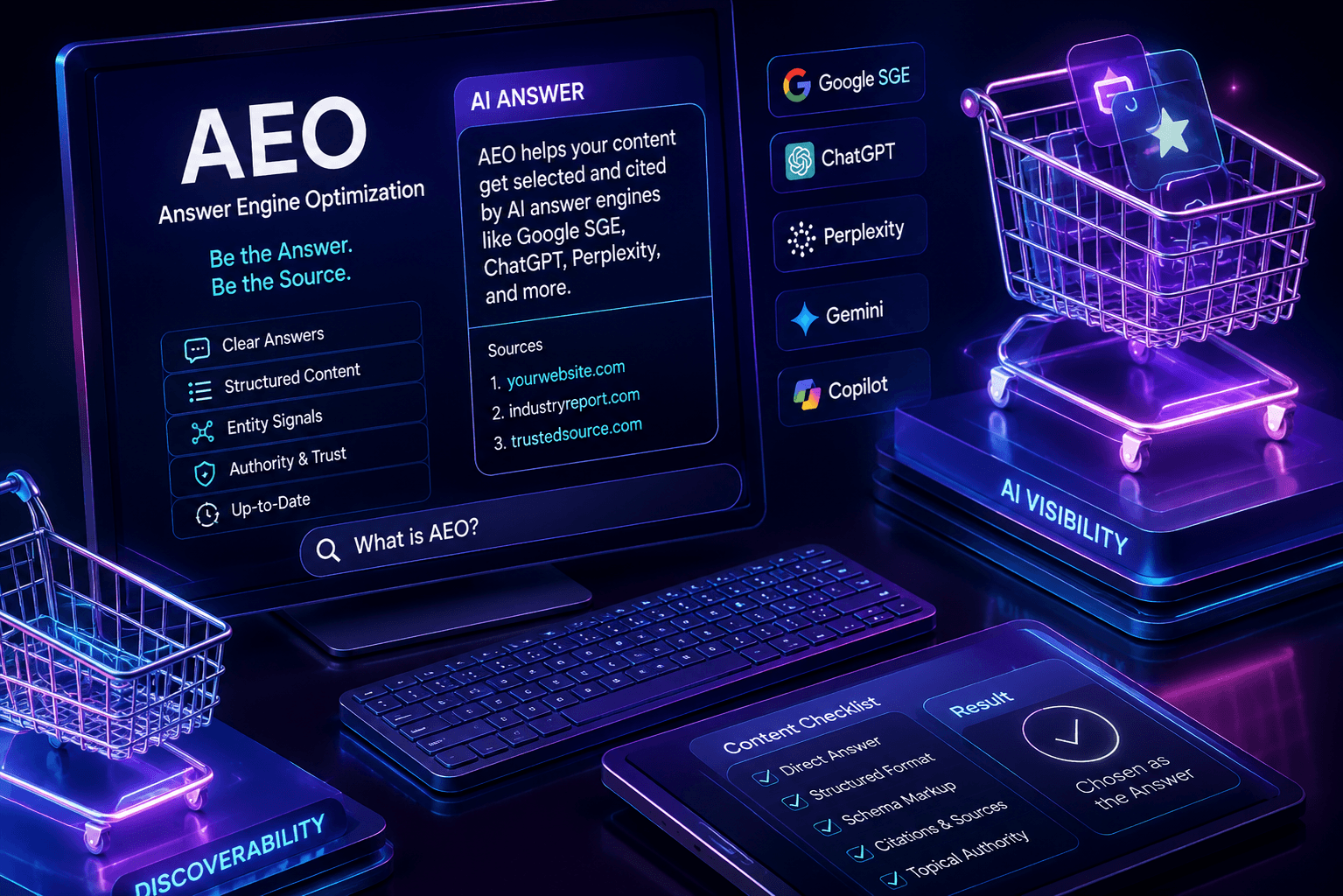
What Is Answer Engine Optimization (AEO)? A Simple Guide for Arizona Businesses
By the team at Escape Web Development, an engineer and an analyst building AI-ready websites for Arizona businesses. Last updated June 2026.
Answer Engine Optimization (AEO) is the practice of structuring your website's content so AI tools like ChatGPT, Google's AI Overviews, Gemini, and Perplexity can find it, understand it, and hand it back as the direct answer when someone asks a question. Where traditional SEO fights to rank a link on a results page, AEO fights to be the recommendation.
Key takeaways
Answer Engine Optimization (AEO) structures your content so AI tools cite your business as the answer, not just a link in a list.
AEO complements SEO. SEO earns the click, AEO earns the recommendation, and you want both.
AI-search visitors convert at roughly 4.4x the rate of traditional organic visitors (Semrush, 2025), so AEO traffic is low-volume but high-intent.
In Arizona, most local AI answers are still filled by generic national content, which leaves a wide-open opening for local businesses that move now.
The winning tactics are answer-first content, question-based headings, schema markup, visible trust signals, and consistent off-site citations.
Here's the part most Arizona business owners haven't caught up to yet.
For twenty years, getting found meant getting to the top of Google. Your customer typed a few words, Google showed ten blue links, and you fought to be one of them. That game still exists. But underneath it, the way people ask for help is changing, and a lot of that change is happening right here in everyday Valley moments.
Picture a snowbird who just landed in Scottsdale for the winter. They don't know a single local pool company, so they open ChatGPT and ask, "Who's a reliable pool service near Cave Creek?" A homeowner whose AC quits on a 112-degree July afternoon asks Gemini for "the best emergency HVAC repair in the Phoenix area." A new resident asks Perplexity which roofer to trust after monsoon season chewed up their shingles.
In each case, the AI doesn't show ten links. It gives back a short answer with a few recommended names. AEO is how your business becomes one of those names.
And that's where the opening is. Almost nobody local is guarding it yet. Search those exact questions today and the content that gets pulled in isn't even from Arizona companies. It's national articles written by people who've never set foot in Maricopa County. For a local business, that's a gap you can walk straight through.
What is answer engine optimization, in one clear definition?
Answer Engine Optimization is the work of making your content the source an AI cites when it answers a question, instead of just a page a search engine ranks.
An "answer engine" is any AI-powered system that synthesizes a response rather than handing you a list of websites. ChatGPT, Google's AI Overviews, Gemini, Microsoft Copilot, Perplexity, and voice assistants like Siri and Alexa all qualify. They read across enormous amounts of information and write back a single, conversational answer.
That changes the goal. SEO asks, "How do I rank this page?" AEO asks, "How do I get my business named in the answer?" The two overlap, but they're not the same job. More on that just below.
The whole thing comes down to one word: extractability. Can a machine quickly locate the answer on your page, understand it, trust it, and attribute it to you? If yes, you get cited. If it has to dig, it moves on to a competitor whose page made it easy.
Why does AEO matter for Arizona businesses right now?
Because answer engine optimization rewards early movers. Right now, the Arizona businesses that plant a flag get a head start that's hard to take back, and the ground is moving fast under everyone.
A few numbers worth sitting with:
Gartner has projected that traditional search volume could drop by roughly 25% by 2026 as people lean on AI answer tools instead of scrolling results.
More than 400 million people use OpenAI's tools every week. This is mainstream now, not some fringe habit.
Semrush studied this in 2025 and found that visitors who arrived from AI search converted at about 4.4 times the rate of visitors from traditional organic search. Fewer clicks, but far more qualified ones.
This is the rise of zero-click answers, where someone gets what they need without ever visiting a website. It's the same thing featured snippets and Google's AI Overviews already do, answering the question right there on the results page. The visit may not happen, but the buying decision still does.
Read that last one again, because it matters most for a home-services business or a local shop. When someone asks an AI "who should I call," they aren't browsing. They're ready to hire. The AI has already done the filtering, so if you're the name it surfaces, you're talking to a customer who's most of the way to a decision.
Arizona makes this even more lopsided. A huge share of our market is seasonal or brand new: snowbirds, recent transplants, tourists, and people who don't have a "guy" yet and feel no loyalty to anyone. Those are the exact people most likely to ask an AI for a recommendation, because they have no other starting point. The customers most up for grabs are the ones AI is quietly choosing for.
AEO vs SEO: what's the actual difference?
AEO and SEO are complementary, not competing, but they optimize for different things.
SEO (the link game) | AEO (the answer game) | |
|---|---|---|
The goal | Rank a page and earn the click | Be the cited source in the AI's answer |
What the user does | Types keywords, scans links | Asks a full question, reads one answer |
What you optimize | The whole page, for ranking | Clear chunks of content, for extraction |
How trust is judged | Backlinks, domain authority | Citation authority, clarity, credibility signals |
How you measure it | Rankings, traffic, clicks | Citations, mentions, share of the answer |
The format that wins | Keyword-rich pages | Direct answers, Q&A structure, clean data |
The short version: SEO helps people find you. AEO helps the AI recommend you. One gets you onto the shelf; the other gets you pointed at when a customer asks which one to grab.
If you want the deeper comparison, we break it down further in LINK: AEO vs SEO — what's the difference. And if the acronyms are piling up (SEO, AEO, GEO, LLMO), our LINK: plain-English decoder sorts them out.
How do answer engines decide who to recommend?
This is where the engineer's lens helps. Answer engines don't choose by magic. They run on a set of signals you can actually influence.
Answer engines tend to favor content that is easy to extract, easy to verify, and clearly trustworthy. In practice, that comes down to four things you can control.
Front-loaded answers
Pages that state the answer in the first sentence or two get pulled more often than pages that bury it under three paragraphs of warm-up. (Notice how this article opens with the answer. That's not an accident.)
Clean structure
Short, self-contained paragraphs. Question-based headings that mirror how people actually ask. Bullet points and small tables for comparisons. The more modular your content, the easier it is for a machine to lift a clean chunk and quote it.
Trust signals
A real author with credentials, a recent "last updated" date, and references to credible sources all tell an AI your page is maintained and reliable. Stale, anonymous content gets passed over.
Off-site corroboration
AI systems look for consensus. If your business shows up consistently across the places they already trust, like your Google Business Profile, local directories, review sites, and regional press, you're far more likely to be surfaced. For a local business, keeping your name, address, and phone number identical everywhere isn't busywork. It's an AEO signal.
One reassuring fact for anyone worried this means tearing up their SEO: research has found that roughly 99% of the URLs cited in Google's AI Mode also appear in the top 20 organic results. Strong SEO and strong AEO pull in the same direction. You're not choosing between them.
What does an AEO strategy actually involve?
An answer engine optimization strategy isn't exotic. Here's the practical playbook with the jargon stripped out. Most of it is just disciplined content put into a shape AI can read.
Lead with the answer. Under each question on your site, put a direct, 2-3 sentence answer first. Context and detail come after, for the humans who want it.
Write the way people ask. Use real questions as your headings. "How much does a new AC cost in Phoenix?" beats "Pricing Information." Natural, conversational language matches how people talk to AI.
Add structured data. FAQ and Article schema markup is code that tells search engines and AI exactly what your content is. It's one of the highest-leverage technical moves in AEO, and it's invisible to your visitors.
Build a trust block. Put the author, their credentials, a last-updated date, and a source or two near the top of important pages. It reassures both the AI and the human.
Earn off-site mentions. Get cited where AI already looks: local directories, review platforms, community groups, and regional publications. Keeping your business details consistent across all of them reinforces the signal.
Keep it fresh. Answer engines reward recency. Updating facts and refresh dates on an existing page is cheaper than writing a new one and often does more for visibility.
If your site is also where you capture the lead once the AI sends someone your way, it helps to think of the whole thing as one connected system. That's part of why we pair AEO with tools like an LINK: AI chatbot or booking widget that catches the customer the moment they land.
Do you still need SEO if you're doing AEO?
Yes. AEO doesn't replace SEO. It extends it.
The cleanest way to think about it: SEO drives traffic to your site, and AEO builds your presence inside the AI answers where more and more decisions now start. You need both. A business that nails SEO but ignores AEO is invisible the moment a customer asks an assistant instead of typing a search. A business that chases AEO with no SEO foundation has nothing solid for the AI to trust in the first place.
For Arizona businesses, the smart move is to treat your website as a single asset that does both jobs at once. It ranks in search and gets cited by AI. A well-structured, clearly written, trustworthy page wins on both fronts, while a dated or confusing one quietly works against you on every one of them. If you're not sure where yours stands, 7 Signs Your Website Design Is Quietly Losing You Customers is a fast gut-check, and we cover the fundamentals in LINK: why SEO still matters for your business.
How do you know if your AEO is working?
Measuring AEO means tracking different things than you would for SEO. The simplest check is one you can run yourself in five minutes.
Just ask the AI. Open ChatGPT, Gemini, and Perplexity and type the exact questions your customers would ask: "best [your service] in [your town]," or "who should I hire for X near me." See whether you come up. Screenshot it. Do it again next month. That manual check is the most honest signal there is. It also doubles as a sales asset, since you can show a prospect in writing that the AI is already naming you.
For something more structured, the metrics that matter in AEO are:
Visibility: how often an AI mentions your business at all.
Citation: how often it actually links to or cites your site.
Share of answer: how often you show up versus competitors for the same question.
Sentiment: whether the AI describes you in a positive light.
Notice none of these are "traffic." That's the mental shift AEO asks for: success is being named and trusted in the answer, even when the customer never clicks through to your page before picking up the phone.
How to get started with AEO in Arizona
Getting started with answer engine optimization in Arizona doesn't mean overhauling everything at once. Start where buyer intent is highest and competition is lowest.
Pick the handful of questions your best customers actually ask, the ones that come up right before they hire someone. Rewrite (or build) the pages that answer those questions in the answer-first, clearly structured way described above. Add the schema. Tighten up your Google Business Profile and make sure your business details are identical everywhere they appear online. Then run the AI check, screenshot what you find, and improve from there.
The reason to move now is simple: this is a window. Right now the AI answers for Arizona home-services and local-business questions are being filled by generic national content because almost no local company is competing for them. That won't last. The businesses that show up as the trusted, local, cited answer over the next year will be very hard to dislodge once the AI has learned to name them.
Frequently asked questions about answer engine optimization (AEO)
Will AEO replace SEO? No. AEO complements SEO rather than replacing it. Keep optimizing for organic search to drive traffic, while structuring your content to be the cited answer in AI results. Both contribute to one complete search presence, and the same well-built page usually performs on both.
How long does AEO take to show results? It varies, but many businesses see early movement within weeks once their pages are restructured with direct answers, schema markup, and credible signals. Consistent updates and monitoring speed things up as you learn which patterns earn citations.
What are answer engines? Answer engines are AI-powered tools that give a synthesized response instead of a list of links. Examples include ChatGPT, Google's AI Overviews, Gemini, Microsoft Copilot, Perplexity, and voice assistants like Siri and Alexa.
Do backlinks still matter for AEO? They still signal authority, but AEO puts more weight on being present and cited in sources the AI already trusts than on raw link volume. For local businesses, consistent mentions across reputable directories, review sites, and your Google Business Profile carry real weight.
Can a small Arizona business actually compete at AEO? Yes, arguably more easily than at traditional SEO. Because most local AI answers are currently being filled by generic national content, a focused local business that answers the right questions clearly and earns consistent local mentions can become the cited answer with far less competition than a crowded Google results page.
Want to see if AI is already recommending your competitors?
That's a five-minute check we'll happily run with you. At Escape Web Development, we build websites for Arizona businesses that are made to do both jobs at once. They rank in search and get cited by AI, because we do exactly this for our own business and can show you the screenshots to prove it.
We're an engineer and an analyst, not a sales floor. If AEO is the frontier nobody local is guarding yet, we'd rather help you plant a flag on it.